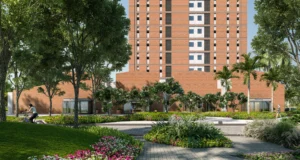
Alembic City in Vadodara represents a new way of thinking about urban development in India. Instead of approaching sustainability as a checklist applied to individual buildings, Alembic City adopts a campus-scale perspective one that integrates energy, water, landscape, mobility, and material decisions into a single, long-term system. This shift positions Alembic City not merely as a commercial development, but as a benchmark for how future-ready urban campuses should be planned.
As India’s cities expand and businesses increasingly seek responsible, efficient office environments, campus-led sustainability is emerging as the most resilient model. Alembic City demonstrates how this approach can work at scale, particularly for new commercial projects and premium office space in Vadodara.
Why Campus-Scale Sustainability Matters
Traditional real estate development often treats each building as a standalone entity. While this approach can achieve regulatory compliance, it misses larger opportunities for efficiency and environmental performance. Energy demand, water use, biodiversity, and mobility patterns do not stop at a building boundary they operate across entire precincts.
By planning at the campus level, Alembic City enables shared infrastructure, coordinated design strategies, and long-term operational efficiencies. District-level energy planning, integrated water systems, and connected green spaces become feasible, reducing both environmental impact and operational costs. This is a fundamental shift from compliance-driven development to performance-driven urban design.
Embodied Carbon and Alignment with Global Benchmarks
Sustainability discussions are increasingly focused on embodied carbon the emissions associated with materials, construction, and the full life cycle of buildings. As operational energy use becomes more efficient, embodied carbon can account for a significant portion of a project’s total climate impact.
Alembic City’s campus approach allows embodied carbon to be addressed strategically. Material choices, structural systems, and construction methods can be evaluated across multiple buildings rather than in isolation. This makes it possible to align with global best practices such as whole-life carbon assessment, low-carbon concrete strategies, optimized structural design, and adaptive reuse where feasible.
By benchmarking embodied carbon against international standards and publishing transparent performance data, Alembic City has the potential to set a new reference point for responsible commercial development in India.
Operating Energy Efficiency and Long-Term Performance
Energy efficiency remains a core pillar of sustainable office environments. The most widely used metric is Energy Performance Index (EPI), measured in kilowatt-hours per square meter per year. Efficient commercial buildings globally aim to significantly reduce this figure through passive design, efficient building envelopes, advanced HVAC systems, smart controls, and renewable energy integration.
At the campus scale, Alembic City can optimize energy use through shared systems such as centralized cooling, rooftop and ground-mounted solar installations, and coordinated load management. This approach often achieves lower overall energy intensity than isolated building-level solutions.
For businesses seeking office space in Vadodara, this translates into predictable operating costs, improved indoor comfort, and alignment with corporate ESG goals.
Water Conservation Through Circular Systems
Water scarcity is a growing concern for urban India, making water stewardship a critical aspect of sustainable development. Alembic City’s integrated campus model supports circular water systems that reduce dependence on freshwater sources.
Rainwater harvesting, on-site wastewater treatment, and reuse for non-potable applications such as landscaping and cooling systems can be implemented efficiently at scale. Landscapes can be designed as functional stormwater systems, reducing runoff while enhancing groundwater recharge.
Such a closed-loop approach not only conserves water but also improves long-term resilience, making the campus more self-sufficient and future-ready.
Tree Preservation and Landscape-Led Design
One of the most visible indicators of sustainability is how a development responds to its natural context. Preserving mature trees and integrating them into the design from the outset delivers multiple benefits carbon sequestration, reduced heat island effect, improved microclimates, and enhanced well-being for occupants.
Alembic City’s master planning approach allows buildings, pathways, and public spaces to be shaped around existing trees rather than replacing them. This landscape-led design philosophy transforms green assets into central elements of the campus experience, reinforcing the idea that sustainability and livability go hand in hand.
Campus Sustainability Versus Single-Building Compliance
While green building certifications remain important, they often focus on individual structures. Campus-scale sustainability goes further by enabling shared resources, coordinated performance targets, and system-level efficiencies that single buildings cannot achieve alone.
Alembic City demonstrates how a campus can function as an interconnected ecosystem optimizing energy, water, waste, and biodiversity across multiple uses. This holistic approach delivers lower environmental impact, greater operational resilience, and higher long-term value for occupants and investors alike.
Implications for New Commercial Projects and Office Space in Vadodara
For companies evaluating new commercial projects or office space in Vadodara, sustainability is no longer optional; it is a strategic requirement. Developments that can demonstrate measurable performance in energy efficiency, carbon reduction, and resource management are better positioned to attract high-quality tenants and long-term investment.
Alembic City’s campus-scale vision responds directly to this shift. By embedding sustainability into its planning framework, it sets a higher standard for commercial real estate in the region and signals where the future of urban development is headed.
Setting a Benchmark for the Future
What ultimately distinguishes Alembic City is not any single sustainability feature, but the integrated thinking behind the entire development. By addressing embodied carbon, operational energy, water circularity, and ecological preservation at the campus level, Alembic City moves beyond short-term compliance toward long-term performance.
In doing so, it positions itself as a reference point for sustainable urban campuses in India demonstrating how thoughtful planning today can create resilient, efficient, and future-ready commercial environments for decades to come.