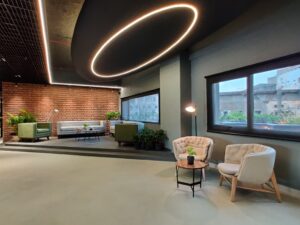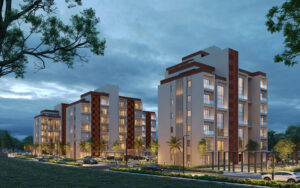
A decade ago, picking an office in a city like Vadodara came down to a short list. Carpet area, rent, a couple of parking slots, and whether the landlord would actually fix the lift. Put the same question to a founder or an HR head today and the list gets longer. Much of it has nothing to do with the four walls: how far their people will travel, what’s within walking distance at lunch, whether the building is green-certified, and whether the lease lets them add a team next year without moving.
That change is reshaping what office spaces in Vadodara need to offer. Below, we look at where the shift came from, what businesses now expect from a modern office development, and what to check before you sign for commercial space in the city.
HOW HAVE OFFICE SPACES CHANGED OVER THE LAST DECADE?
Offices have moved from being a fixed overhead to being a tool for hiring and keeping talent. Rent still matters, but it now sits alongside commute time, amenities, green certification and lease flexibility. Demand is also spreading beyond the metros as global capability centres and flexible workspace operators expand into Tier-2 cities.
The market numbers reflect it. India recorded 82.6 million sq ft of office leasing in 2025, a record for the third year running (Source: CBRE India Office Figures Q4 2025). Who is taking that space has changed as well. Global capability centres (GCCs), the in-house technology, finance and engineering hubs of multinational companies, accounted for 37.7% of gross leasing in 2025. Flexible workspace operators reached a record 26.6% share in the final quarter of the year (Source: JLL India, January 2026).
The pandemic usually gets the credit for all of this. Some of it is deserved. But in India the bigger push has come from who is hiring. A GCC competing for data engineers, or a pharma company competing for research scientists, cannot afford an office that people try to avoid.
WHAT DO BUSINESSES EXPECT FROM A MODERN OFFICE DEVELOPMENT?
Six expectations come up again and again in conversations with occupiers. Taken together, they explain why two buildings with the same rent can get very different responses from the same company.
A LOCATION PEOPLE WILL ACTUALLY COMMUTE TO
The office now has to earn the trip. In CBRE’s 2026 Americas Office Occupier Sentiment Survey, 89% of employers said they require at least three office days a week, and the two biggest things holding attendance back were an inconvenient location (62%) and a lack of amenities (53%) (Source: CBRE, July 2026). That survey covers US occupiers. The pressure it describes applies to any company asking its people to come back to their desks.
For Vadodara, this puts real weight on central addresses close to the railway station, the airport and established residential neighbourhoods. A short commute helps you hire. A long one shows up in your attrition numbers sooner or later.
FLEXIBILITY IN THE LEASE AND THE FLOOR PLATE
Traditional leases assumed a company knew its headcount five years out. Very few do. That is a large part of why flexible and managed offices have grown so fast. Flex penetration of India’s office transactions went from about 5% in 2017 to 21% in 2025, and large enterprises now occupy about 72% of flex seats, against 10% for startups (Source: GHAR.tv research, June 2026).
In practice, businesses want a building, or better, a campus, that offers a spread of floor plate sizes, a co-working option for a pilot team, and room to expand without changing address. A company that starts with a handful of desks and grows into a full floor should not have to reprint its visiting cards to do it.
AMENITIES THAT GIVE PEOPLE A REASON TO COME IN
CBRE’s 2025 India Office Occupier Survey found that 73% of companies plan to use physical workplace design as a key focus area for improving the office experience (Source: CBRE India, 2025).
Interior design is only half the picture, though. Employees also judge an office by what is around it. Is there somewhere decent to eat? A shaded path to walk between meetings? A hospital nearby if something goes wrong? A place to take a client that is not the conference room?
This is where a standalone tower on a busy arterial road tends to struggle. It can have a beautiful lobby and still leave its occupants with nothing to do at lunch except order in and eat at their desks.
GREEN CERTIFICATION AS A STARTING POINT
Sustainability used to be a brochure feature. Now it is a filter. Occupiers increasingly treat LEED and IGBC certification as the minimum standard for premium office space (Source: CBRE India, January 2026), and 63% of firms have ESG goals defined specifically for their real estate portfolio (Source: CBRE 2025 India Office Occupier Survey). CBRE also found that about 84% of new office supply in the period it studied was green-certified, with 77% of leasing happening in those buildings (Source: CBRE, via The Flex Insights, December 2025).
For a multinational tenant, certification is often non-negotiable because the parent company reports emissions globally, and an uncertified building makes that reporting harder. For a smaller business the benefit is quieter: more daylight at the desk, better air, and buildings designed to use less power and water.
INFRASTRUCTURE THAT JUST WORKS
Nobody posts about power backup on LinkedIn. Everybody remembers the outage that cut off a client call. Dedicated parking, reliable backup power, professional facility management and well-planned internal roads rarely win a leasing decision on their own. Leave one out and you can lose the deal.
THE OPTION TO LIVE CLOSE TO WORK
This one is newer. Mixed-use developments, where homes, schools, healthcare and offices share a single masterplan, turn the commute into a walk for employees who want that. It will not appeal to everyone. For companies relocating senior staff from a metro, it can make the move much easier to agree to.
WHY THE MOVE TOWARD TIER-2 CITIES MATTERS FOR VADODARA
Colliers expects GCC leasing in India to reach 60–65 million sq ft over 2026–2027, and says Tier-II cities are likely to see a steady rise in GCC activity on the back of cost advantages, infrastructure and talent availability (Source: Colliers India, GCCs in India report). JLL puts the cost gap at 10–35% lower in Tier-II cities compared with major hubs, with access to quality talent still intact (Source: JLL India GCC Office Guide, March 2026).
Gujarat has put policy behind this. The Gujarat Global Capability Centre Policy 2025–30 aims to attract at least 250 new GCC units and generate more than 50,000 jobs in the state (Source: Department of Science & Technology, Government of Gujarat), with more than ₹10,000 crore in expected investment (Source: Analytics India Magazine, February 2025). Vadodara is listed among the planned GCC clusters, alongside GIFT City, Ahmedabad, Gandhinagar and Surat (Source: Inductus GCC, February 2025).
A fair word of caution. Vadodara is not the right base for every business. If your team needs daily, in-person time with clients in Mumbai or Delhi, a Tier-2 office adds travel you will feel every week. The city makes the most sense for teams that serve clients digitally, and for R&D, engineering and shared-services functions that need room to grow without metro rents.
WHAT TO CHECK BEFORE YOU LEASE OFFICE SPACE IN VADODARA
If you are shortlisting office spaces for lease in Vadodara, these are the checks that save the most regret later:
- Map where your team lives before you map buildings. Plot your employees’ home locations first. The most common mistake is choosing a building that is convenient for the founder and inconvenient for everyone else.
- Ask for the green certificate, not the green story. “Sustainable design” in a brochure is not a rating. Ask for the certification body and level, and look the project up on the certifier’s public directory.
- Confirm there is room to grow on the same campus. Ask what floor plates are available now and what is coming. Moving offices in three years costs more than a slightly higher rent today.
- Get parking and power backup in writing. Allocation per tenant, backup capacity and who pays for diesel or maintenance should be in the lease, not in an email.
- Walk the surroundings at lunchtime. Food options, green space and healthcare within walking distance matter more to your team than the lobby finish.
- Read the lease terms carefully. Lock-in period, rent escalation, fit-out responsibility and exit clauses shape your real cost far more than the headline rent.
ALEMBIC CITY: OFFICE SPACES IN VADODARA SHAPED AROUND THESE EXPECTATIONS
Alembic City sits on land in central Vadodara where Alembic began operations in 1907, and its footprint now covers 200 acres within the city centre. The township is 2.6 km from Vadodara Junction and 6.7 km from Vadodara Airport, with Bhailal Amin General Hospital 0.1 km away inside the township and InOrbit Mall next door (Source: Alembic City).
Its commercial district has about 1 million sq ft of built space (Source: Alembic City), and it mixes restored heritage buildings from Alembic’s industrial past with newer green-certified offices. Around them are residential projects, schools, the Arts District, dining, sports areas and landscaped sit-outs. That combination addresses several of the expectations above in one place: a central commute, amenities outside the office door, and the option for employees to live within the same township.
Some of the commercial buildings on campus:
| Building | What it is |
| Business Park East | Green commercial office building completed in 2017 |
| Ficus Court | Three commercial buildings arranged around mature trees, including a banyan, with elongated footprints for natural light |
| The SHED | A mid-1920s engineering shed converted into a contemporary office complex next to the Arts District |
| 1965 Building | Former raw-material store for the fermentation plant, now housing offices and co-working spaces |
| Business Park West | Home to the Alembic Research Centre |
The campus also includes the 1907 Building, the original headquarters of Alembic Chemical Works; the Corporate Building, designed 1963; the column-less 1961 Building with its curved hack-arch roof; and the Fermenter building (Source: Alembic City).
On the practical side, Alembic City offers floor plates for everything from small offices to large corporate requirements, along with dedicated parking for tenants, power backup, facility management and an internal road network (Source: Alembic City). Sanjay Shembekar, CEO of Lone Oak Solutions, has spoken about how his team values life beyond work on campus and being surrounded by like-minded companies (Source: Alembic City).
If you are evaluating commercial properties for lease in Vadodara, you can reach the Alembic City leasing team at +91 96876 39706 or leasing@alembic.co.in, or send an enquiry through the contact page.
FREQUENTLY ASKED QUESTIONS
WHAT DO BUSINESSES LOOK FOR IN OFFICE SPACES IN VADODARA?
Beyond rent and carpet area, businesses now weigh commute time for employees, amenities around the building, green certification, reliable parking and power backup, and room to expand on the same site. Companies hiring for technology, R&D or global operations also look closely at a location’s ability to attract talent.
DOES GREEN CERTIFICATION MATTER FOR A SMALL BUSINESS?
Yes, though for different reasons than for a multinational. A smaller business may not have ESG reporting obligations, but certified buildings are designed for better daylight, air quality and efficient use of power and water, which affects both employee comfort and running costs.
WHAT OFFICE SPACES FOR LEASE IN VADODARA DOES ALEMBIC CITY OFFER?
Alembic City’s Vadodara campus includes Business Park East, Ficus Court, The SHED, 1965 Building, Business Park West and several restored heritage buildings, with office options ranging from co-working to large corporate floors. For current availability, contact the leasing team at +91 96876 39706 or leasing@alembic.co.in.