Retail design is entering a defining decade. Across Indian cities, traditional shopping formats are giving way to environments that are sustainable, walkable, and deeply integrated with everyday urban life. Retail is no longer just about transactions, it is about experience, access, wellbeing, and carbon-conscious living.
Developments such as Alembic City reflect this shift toward future-facing retail environments, where commerce is planned as part of a larger urban system rather than as an isolated destination. This evolution is especially relevant for India, where population density, mobility challenges, and climate considerations demand more integrated solutions.
Retail Is No Longer a Standalone Destination
For decades, retail was designed as a place people traveled to malls, high streets, or commercial zones disconnected from where people lived or worked. That model is increasingly unsustainable. Long commutes, traffic congestion, and energy-intensive buildings are no longer aligned with how cities need to function.
In the next decade, retail will succeed when it is embedded within mixed-use urban campuses. In developments like Alembic City, retail coexists with offices, residences, and public spaces, allowing daily needs to be met without long-distance travel. This transition positions retail as part of everyday urban infrastructure rather than a one-time destination.
Walkability as the New Retail Currency
Walkability has emerged as one of the most important drivers of retail success. People are more likely to engage with retail spaces that are comfortable, shaded, safe, and accessible on foot. In Indian cities, where short trips dominate daily life, walkable retail environments significantly reduce dependence on private vehicles.
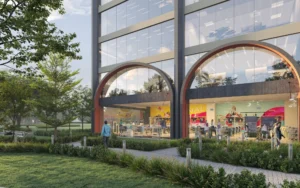
Designing for walkability means prioritizing human-scale streets, active frontages, climate-responsive shading, and seamless connections to workplaces and homes. Campuses like Alembic City demonstrate how walkable retail streets can enhance footfall while also lowering emissions and improving urban quality.
Mixed-Use Living Enables Low-Carbon Consumption
Sustainability in retail is no longer limited to efficient lighting or green materials. The real carbon impact lies in how people reach retail spaces and how often they use them. Mixed-use living directly supports low-carbon consumption by shortening distances between homes, offices, and shops.
When retail is integrated into mixed-use campuses such as Alembic City, everyday activities buying groceries, dining, accessing services happen within walking distance. This reduces transport-related emissions and supports more frequent, local, and sustainable consumption patterns.
Retail as a Contributor to Urban Wellbeing
Retail spaces increasingly play a social and cultural role in cities. Beyond commerce, they act as places for interaction, relaxation, and community life. Well-designed retail environments can support mental wellbeing by offering open spaces, greenery, seating, and opportunities for informal social engagement.
In integrated developments like Alembic City, retail is planned alongside landscaped plazas, pedestrian corridors, and public amenities. This approach transforms retail from a purely commercial function into an active contributor to urban wellbeing and livability.
Tree Preservation and Landscape-Led Design
One of the most visible indicators of sustainability is how a development responds to its natural context. Preserving mature trees and integrating them into the design from the outset delivers multiple benefits carbon sequestration, reduced heat island effect, improved microclimates, and enhanced well-being for occupants.
Alembic City’s master planning approach allows buildings, pathways, and public spaces to be shaped around existing trees rather than replacing them. This landscape-led design philosophy transforms green assets into central elements of the campus experience, reinforcing the idea that sustainability and livability go hand in hand.
sustainability as a Core Retail Design Principle
Future-ready retail must respond to climate realities. Passive design, energy-efficient systems, water-conscious landscaping, and adaptive reuse are becoming baseline expectations rather than optional features. At a campus scale, developments such as Alembic City can implement shared sustainability infrastructure efficient energy systems, water reuse networks, and waste management strategies that serve retail alongside other uses. This systems-based approach is far more effective than treating each retail building independently.
The Next Decade Belongs to Integrated Retail Campuses
Looking ahead, the most resilient retail environments will be those that are deeply integrated with their urban context. Integrated retail campuses bring together commerce, mobility, living, and sustainability into a single framework.
Alembic City represents this next-generation model, where retail supports daily life rather than competing for attention. By aligning retail design with walkability, mixed-use living, and environmental responsibility, such campuses set a new benchmark for how Indian cities can grow more efficiently and humanely.
The future of retail lies not in larger malls or louder destinations, but in thoughtful integration. Sustainability, walkability, and mixed-use living are no longer trends they are necessities for urban resilience.
As Indian cities evolve, integrated developments like Alembic City illustrate how retail can function as part of a low-carbon, people-centric urban system. Over the next decade, this approach will define not just successful retail spaces, but successful cities themselves.